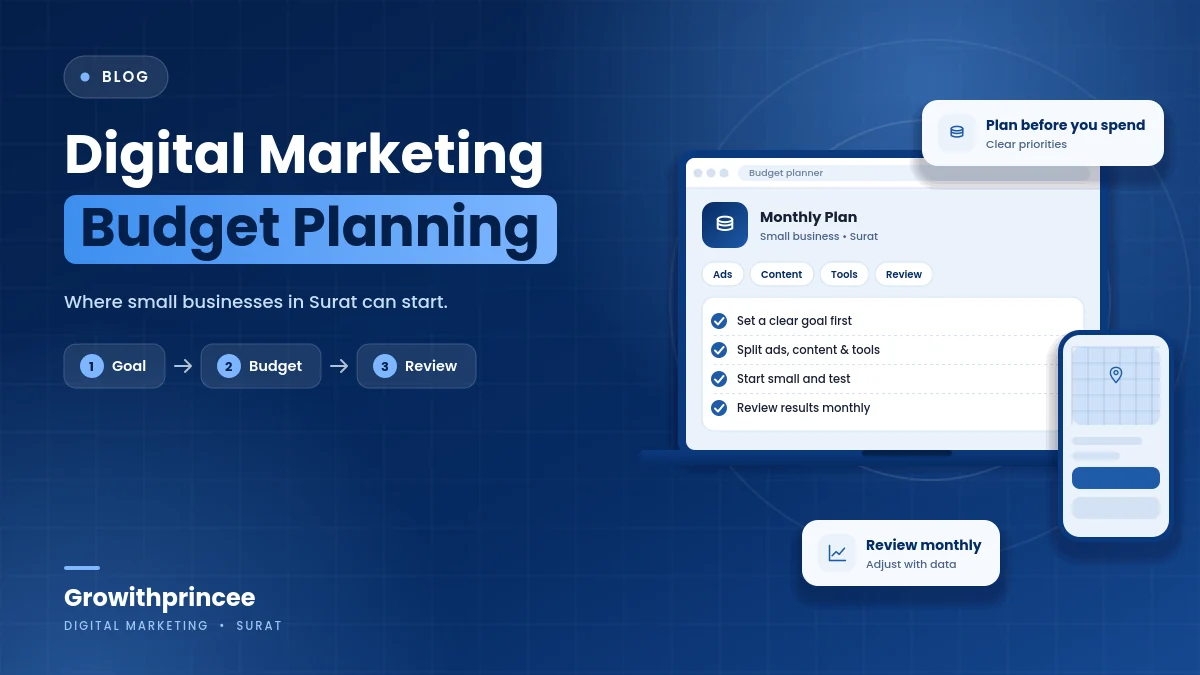
Digital Marketing Budget Planning for Small Businesses in Surat: Where to Start
Planning a digital marketing budget starts with separating three kinds of cost, working backwards from your goal and testing before you commit. This guide helps small businesses in Surat decide how much to spend, where to start and how to review results before scaling.
Table of Contents
Table of Contents
Why a digital marketing budget needs a plan
Many owners ask, “How much should I spend?” There is no single right number. The answer depends on your margins, your goal, your competition and how well the rest of your business converts attention into sales. A digital marketing budget is a plan for how to learn what works with limited money, then invest more in it.
The aim is not to spend as little as possible or as much as you can afford. It is to spend enough to get reliable information and then to grow what is profitable.
Separate three kinds of cost
Confusing costs causes many arguments with agencies and many wrong conclusions. Keep three groups separate:
- Fees: what you pay an agency, freelancer or employee for planning, creative and management.
- Ad spend: money paid to platforms such as Google and Meta for clicks and impressions.
- Tools and production: website, hosting, photography, video, design, CRM, call tracking and other tools.
Write each in your digital marketing budget so you know what is included. Ad spend is not an agency fee; it goes to the platform. Ask any provider to show how these are separated in the proposal. Our guide to how to choose a digital marketing agency in Surat lists the questions to ask.
Work backwards from your goal
Start with the result you want and calculate backward. Suppose you want ten new customers a month. If one in four enquiries becomes a customer, you need about forty qualified enquiries. If a typical qualified enquiry costs a certain amount to generate, you can estimate the budget. These numbers are rough at first, so use them as a starting hypothesis, then replace them with real data from a test.
Also consider the lifetime value of a customer. A client who returns many times justifies a higher acquisition cost than a one-time buyer. Know your margins so that you do not spend more to acquire a customer than they are worth.
Start with a test, not a big commitment
Begin with a defined test, for example four to six weeks, with a fixed budget and clear success measures such as cost per qualified enquiry. Choose one or two channels, one main offer and one landing page. Keep other things constant. At the end, review the data: what worked, what did not and what you learned.
This approach reduces risk. If it works, you can scale with confidence. If it does not, you can adjust the offer, page or channel before spending more. Our comparison of Meta Ads vs Google Ads helps you choose where to test first.
Invest in basics that make every rupee work harder
Before buying traffic, fix the basics: an accurate Google Business Profile, a fast mobile website, a clear offer, a simple enquiry process and quick replies. These often cost less than ads and raise the return on all other spending. See our Google Business Profile optimization guide and landing page checklist.

A reasonable digital marketing budget includes some money for these foundations, not only for ads.
Review and reallocate
Every month, review each channel: spend, enquiries, cost per enquiry, qualified enquiries and sales. Move money from weak channels to stronger ones gradually. Keep a small portion for experiments. Revisit your assumptions about conversion rates and customer value. A digital marketing budget is a living document, not a one-time decision.
Avoid common mistakes
- Spreading a small budget across too many channels.
- Judging results after a few days.
- Ignoring follow-up, which wastes the leads you paid for.
- Mixing fees with ad spend and misreading cost per lead.
- Copying a competitor’s budget without knowing their margins.
- Stopping just before the learning phase ends.
For industry examples, read how local service providers and gyms and fitness studios approach budgets. Our marketing strategy consulting and performance marketing services can help you plan.

Key takeaways on digital marketing budget
- Separate agency or freelancer fees, ad spend and tools so you can read the numbers.
- Work backwards from the customers and revenue you need.
- Start with a test, invest in basics that make every rupee work harder, and review monthly.
- Avoid common mistakes such as spreading too thin and judging too early.
Growithprincee is a certified digital marketing agency in Surat. We have consulted and worked with 40+ brands and share live results with our clients. If you need help setting a realistic digital marketing budget, contact our team.
Frequently asked questions
What percentage of revenue should I spend on marketing?
There is no universal rule. It depends on your industry, growth goals and margins. Start from the numbers you need and test.
Can I start with a very small budget?
Yes, but be realistic about what you can learn. Focus first on free and low-cost basics such as your Google profile, reviews and WhatsApp follow-up, then add a small paid test.
Should I pay an agency or hire someone in-house?
An agency offers a team and process, while an in-house hire offers daily availability. Many small businesses begin with an agency or consultant and bring tasks in-house as they grow.
How long before I see a return?
It varies. Some channels produce enquiries within weeks, while others, such as SEO, take months. Plan for a test period before judging.
Related reading
- Surat business lead generation
- Meta Ads agency in Surat: what to expect
- Performance marketing: what an agency does
For the official guidance behind this topic, read the Google Ads Help.
