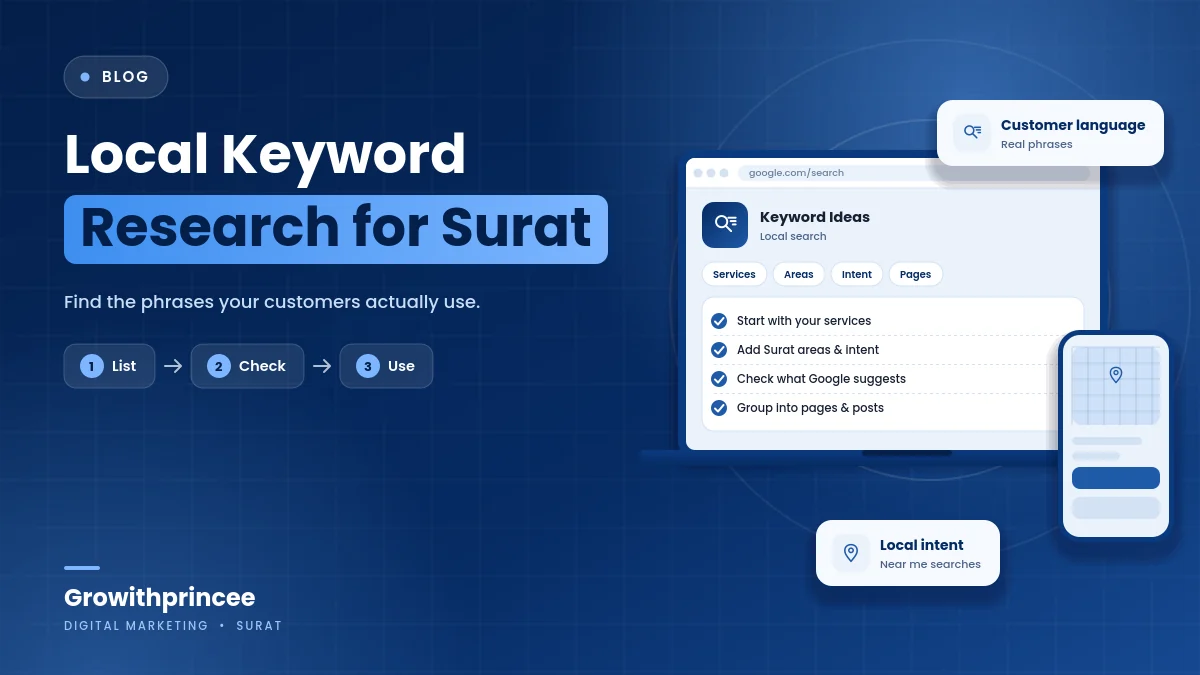
Local Keyword Research for Surat: How to Find the Phrases Your Customers Actually Use
Good local keyword research for Surat starts with the words your customers actually use, not the words you assume. This guide shows how to understand search intent, use area terms carefully, handle Gujarati, Hindi and English variations, check the results page and choose realistic targets for each page.
Table of Contents
Table of Contents
What local keyword research really means
Keyword research is the process of finding the phrases people type or say when they look for what you offer. local keyword research adds a place: Surat, its neighbourhoods and the way locals describe them. Done well, it tells you which pages to create, which words to use in titles and headings and which searches are worth chasing.
It is not about stuffing phrases into pages. It is about understanding customers well enough to write pages that answer their questions. The best local keyword research starts with listening, not with a tool.
Start with what you sell and who you serve
Write down every service or product, and for each one the type of customer, the problem they want solved and the words they use. A dentist might list root canal, braces, teeth whitening and child dentistry. Customers might say “tooth pain”, “cost of braces in Surat” or “dentist open on Sunday”. Collect real phrases from calls, WhatsApp chats, enquiry forms and reviews. These are gold for local keyword research because they are your customers’ own words.
Understand search intent
Every search has a purpose. Some people want to learn (“how to choose a CA”), some want to compare (“best interior designers in Vesu”), some want to buy or book (“book AC repair in Pal”) and some want to find a place (“gym near Adajan”). Match your pages to intent. A guide fits a learning search, a service page fits a booking search and a Google Business Profile fits a local “near me” search.
If your page does not match the intent, it will struggle even with the right words. Look at what already ranks to understand what Google thinks people want.
Use area terms carefully
People in Surat search with area names: Adajan, Vesu, Pal, Piplod, Varachha, Katargam, Udhna, Rander, Althan, Citylight and Ring Road. Include area terms where you truly serve the area or are located, such as in your address, service area text and relevant pages. Avoid creating many nearly identical pages that only change the area name; they add little value. Our guide to targeting Surat neighbourhoods with local ads and SEO explains how to do this honestly.
Consider language variations
Many Surat customers search in Gujarati, Hindi, English or a mix written in English letters. A person may type “ac repair near me”, “surat ma best dentist” or “sasta web design”. You do not need to use every variation. Choose the ones that match your audience and use them naturally in headings, FAQs and content. Check how Google shows results for variations; sometimes it treats them as the same intent.

Check what is already ranking
Search for your target phrase in a private browser window and look at the results. Who ranks, what kind of pages are they and what do they include? If the top results are large directories, a small business page may struggle for that phrase and a more specific one may be better. If the results are local businesses with simple pages, you may have a chance. This check takes minutes and saves months.
Use free tools and your own data
Google autocomplete and “People also ask” show real questions. Google Search Console shows the searches that already bring impressions to your site, which are a great source of new ideas. Google Business Profile insights show which searches lead to your profile. Free keyword tools can estimate volume, but treat the numbers as rough. See our Google Search Console guide.

Prioritise realistic targets
Create a simple table with columns for the keyword, intent, target page, difficulty (easy, medium, hard) and priority. Start with specific, lower-competition phrases that match your offer, such as “pediatric dentist in Vesu” before “dentist in Surat”. Once those pages perform, expand. Assign one main keyword to each page and a few related phrases. This avoids pages competing with each other.
Put the research to work
- Use the main keyword naturally in the title, heading and early in the page.
- Answer related questions in subheadings and an FAQ.
- Add internal links between related pages.
- Keep local details consistent with your Google profile.
Our local SEO checklist for Surat businesses and website SEO conversion basics show how to apply what you learn, and our SEO services in Surat are available if you want help.
Key takeaways on local keyword research
- Start with what you sell, who you serve and the problems customers describe.
- Match each keyword to search intent and to a page that truly serves it.
- Use area terms and language variations where they are true and natural.
- Prioritise realistic targets using free tools and your own data.
Growithprincee is a certified digital marketing agency in Surat. We have consulted and worked with 40+ brands and share live results with our clients. If you want expert help with local keyword research, talk to us.
Frequently asked questions
Which keywords are best for a small business in Surat?
Specific phrases that match what you offer and where you serve, such as service plus area, usually work better than broad terms. Choose ones with real search intent.
How many keywords should one page target?
One main keyword and a handful of closely related phrases. Trying to cover too many topics on one page weakens it.
Should I write in Gujarati or Hindi?
If your customers search in those languages, include them where natural. Many local businesses benefit from English pages with Gujarati or Hindi phrases in FAQs.
How often should I update my research?
Review it every few months and after major changes in services, seasons or competition.
Related reading
- AI search visibility for Surat businesses
- Google Business Profile optimization
- Technical SEO basics for small business
For the official guidance behind this topic, read the Google Search Central SEO Starter Guide.
