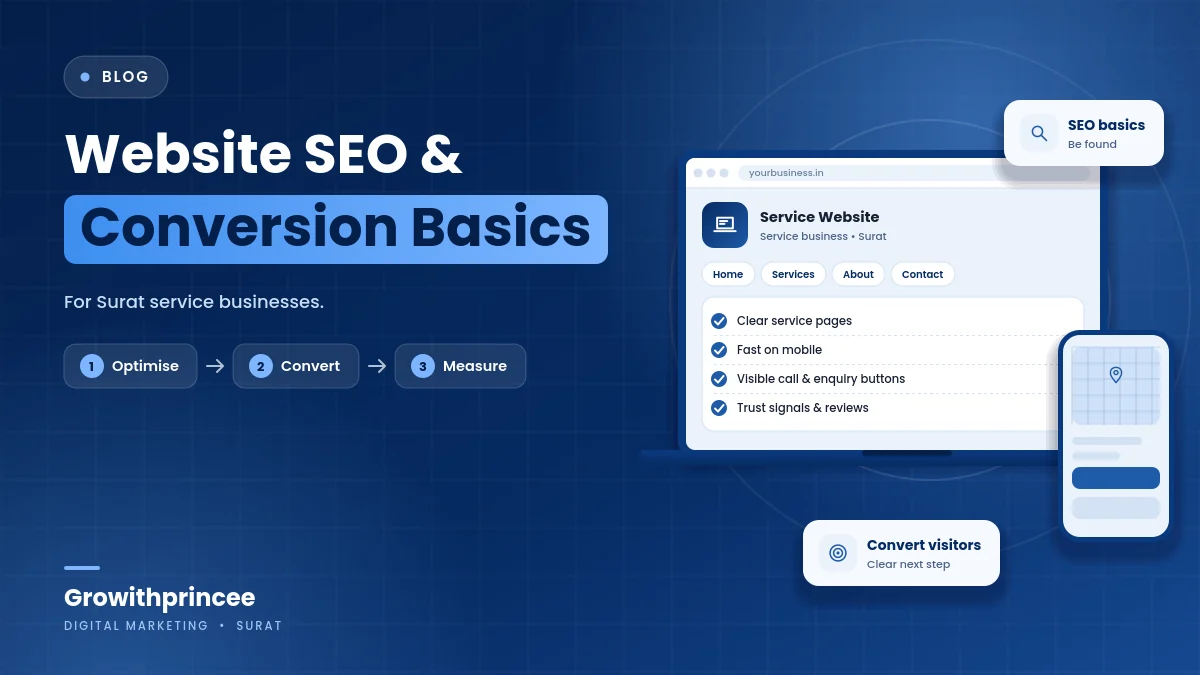
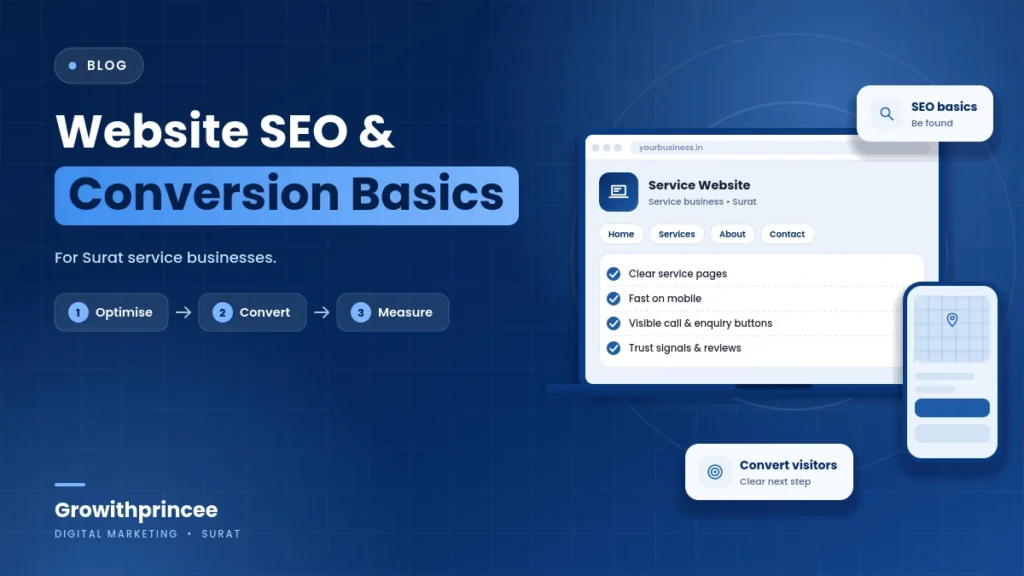
Website SEO and Conversion Basics for Surat Service Businesses
A website that ranks but does not convert wastes traffic, and a website that converts but cannot be found wastes effort. These website SEO conversion basics help Surat service businesses build pages that earn visibility and turn visitors into enquiries, using plain steps that do not need a developer.
Table of Contents
Table of Contents
Why website SEO conversion basics belong together
SEO and conversion work are often treated as separate jobs, but customers experience them as one journey. A person searches, sees your result, clicks, scans the page, decides whether to trust you and then calls, messages or fills a form. If the page does not match the search, they leave. If the page matches but the next step is unclear, they also leave. The website SEO conversion basics below cover both parts of that journey.
These basics suit service businesses such as clinics, coaching classes, interior designers, home service providers, accountants and contractors. Product stores need extra elements such as product listings and checkout, but the principles are similar.
Build pages around customer questions
Start by listing the questions a customer asks before choosing you. What do you do exactly? How much does it cost? How long does it take? Where do you work? How do I know I can trust you? What happens after I contact you? Each major service deserves a page that answers these questions plainly, in the language your customers use.
A page built around real questions tends to rank for a wider range of searches and persuades visitors better than a page stuffed with repeated keywords. Use headings that mirror the questions, short paragraphs and examples from your own work. These website SEO conversion basics start here because everything else depends on useful content.
Write specific titles and headings
The title of a page is the first thing a searcher sees. Make it specific and honest: include the service, the place where relevant and a reason to click. A title such as “Interior Designer in Vesu, Surat: Home and Office Projects” says more than “Home”. Use one clear H1 heading on the page, followed by H2 and H3 headings that structure the content. Write meta descriptions that summarise the page in a sentence or two, without exaggeration.
Avoid duplicate titles across pages. If two pages say the same thing, merge them or give each a distinct purpose. Our local keyword research guide helps you choose the phrases to use.
Show local intent honestly
If you serve Surat, say so clearly: mention the areas you serve, show your address if customers visit you, embed a map and include your phone number and WhatsApp link in a visible place. Use area names where they are true and helpful, but do not create dozens of nearly identical pages that only swap neighbourhood names.
Keep your name, address and phone number consistent with your Google Business Profile. See our Google Business Profile optimization guide and the local SEO checklist for Surat businesses for details.
Link pages into a useful journey
Internal links help visitors and search engines move between related pages. From a service page, link to relevant guides, pricing explanations, case examples and the contact page. From a blog post, link to the service it relates to. Use descriptive link text, such as “home interior design in Surat”, instead of “click here”. Make sure important pages are reachable within a few clicks from the homepage.

A clean menu with a handful of clear options works better than a long one. Add breadcrumbs on deeper pages and a footer with key links and contact details.
Prioritise mobile usability and speed
Most of your visitors will see your site on a phone, often on a mobile network. Check that text is readable without zooming, buttons are large enough to tap, forms are short and pop-ups do not cover content. Compress images, avoid heavy sliders and videos that autoplay, and remove plugins you do not need. Our guide to website speed and Core Web Vitals and the technical SEO basics explain the fixes.
Slow pages hurt both rankings and conversion. Even small delays make people give up, especially when they are searching in a hurry.
Make calls to action clear and track enquiries
Tell visitors exactly what to do next: call now, WhatsApp us, get a quote, book a visit. Place a call to action near the top of the page, again after the main content and in the footer. Use a short form that asks only for what you need, such as name, phone number and a short message. Show what happens next, for example “We reply within two working hours”.
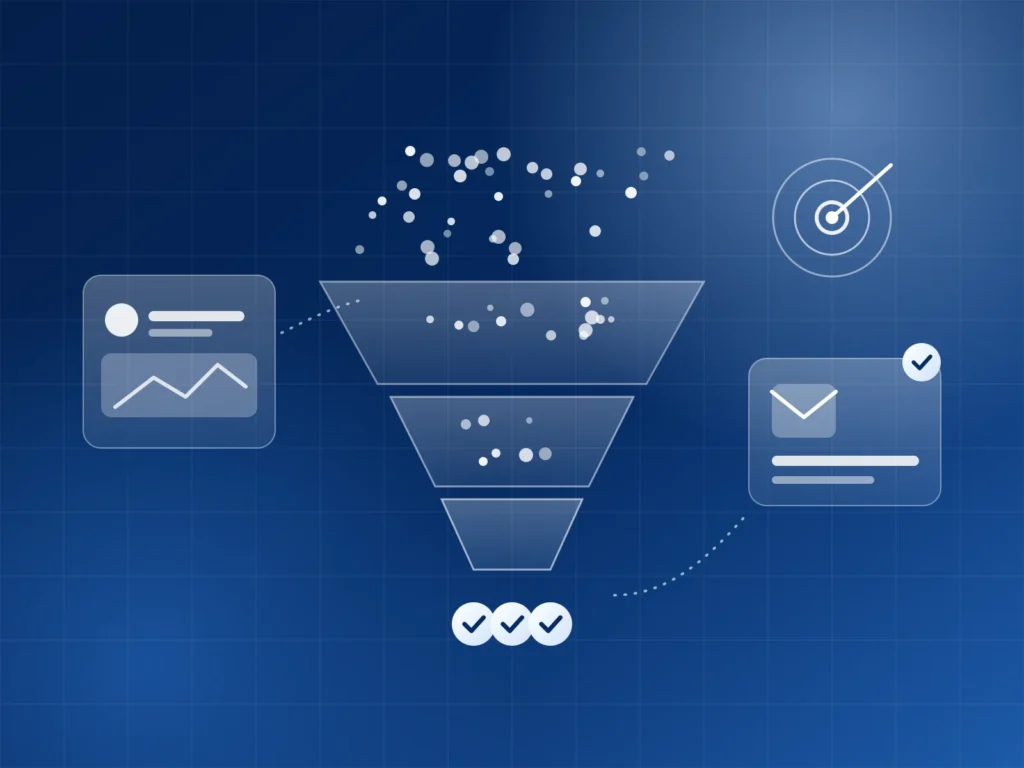
Track the actions that matter: phone calls, form submissions and WhatsApp clicks. Use Google Analytics and Google Search Console to see which pages bring visitors and which turn them into enquiries. Our Google Search Console guide shows how to read the data.
Add trust signals that are real
Trust helps conversion. Show real photos of your team and work, mention how long you have been in business, add reviews and testimonials you have permission to use, display certifications and explain your process. Avoid fake badges, stock testimonials and exaggerated claims. If you cite figures, make sure you can back them up.
A short “about” section on each service page, written by a real person, often works better than a generic block of text.
Use structured data where it is accurate
Structured data, such as local business and FAQ markup, helps search engines understand your page. Only mark up information that is visible and true on the page. Many SEO plugins can add this for you. Check the result with Google’s testing tools and fix any errors.
Improve with simple tests
Once the basics are in place, improve one thing at a time. Try a clearer headline, a shorter form, a different call-to-action button or a better photo. Compare enquiries over a few weeks, keeping other things constant. Small improvements stack up.
Pre-publish checklist for website SEO conversion basics
- The page answers a real customer question and matches search intent.
- The title, H1 and meta description are specific and unique.
- Local details are accurate and consistent.
- Internal links point to related pages and the contact page.
- The page loads quickly and looks right on a phone.
- A call, WhatsApp and form option is visible.
- Tracking is set up and tested.
If you also want help building the site, see our website development services in Surat and SEO services.
Key takeaways on website SEO conversion basics
- Build pages around customer questions, not around keywords alone.
- Write specific titles and headings, and show your local relevance honestly.
- Link pages into a useful journey and make sure the site is quick on mobile.
- Use clear calls to action and track calls, forms and WhatsApp clicks.
Growithprincee is a certified digital marketing agency in Surat. We have consulted and worked with 40+ brands and share live results with our clients. If you want our team to review your site against these website SEO conversion basics, get in touch.
How website SEO conversion basics apply to different service businesses
The same website SEO conversion basics apply to every service business, but the emphasis changes. A clinic should focus on trust and clear information about appointments. A coaching class should explain courses, batches and results honestly, with a simple enquiry form. A contractor should show completed work and give a quick way to request a quote. An accountant should explain services and compliance support in plain words. In each case the page should answer the visitor’s main question within a few seconds and make the next step easy.
If you serve several areas of Surat, think about the way customers describe their location. Many people mention Adajan, Vesu, Pal, Varachha or Katargam rather than the whole city. Mention the areas you truly serve, add a map and give directions if customers visit you. Use real photos of your office or team where possible.
Writing copy that converts
Copy is more than keywords. Start with what the visitor wants, not with your history. Use short sentences, clear benefits and plain language. Replace vague phrases like “best quality service” with specific points such as “same-day site visit”, “fixed quote after inspection” or “classes in small batches”. Address common worries, such as price, time and trust, directly.
Read your page out loud. If it sounds like an advertisement, rewrite it so it sounds like a helpful conversation. Ask someone outside the business to read it and explain what you offer. If they are unsure, your visitors will be too.
Forms, calls and WhatsApp: reduce friction
Every extra field on a form lowers the chance of completion. Ask for the minimum: name, phone number and what the visitor needs. Make the phone number clickable on mobile, and add a WhatsApp button with a pre-filled message. Show opening hours and expected response times. After submission, show a clear thank-you page and send a quick confirmation so the visitor knows you received the request. These small details are among the most effective website SEO conversion basics you can apply.
Page speed and design basics
Simple design wins. Use a clean layout, readable fonts, enough spacing and consistent colours. Keep the most important content above the fold on mobile. Avoid auto-playing videos and heavy animations. Test on a real phone and on a slower connection. Fix problems with large images, too many scripts and cluttered pop-ups. A fast, clear site makes it easier for both customers and search engines to understand what you offer.
Measuring whether website SEO conversion basics are working
Use a simple monthly table with sessions, enquiries, enquiry rate, top pages and top search queries. When a page gets traffic but few enquiries, improve its message, proof or call to action. When a page converts well but has little traffic, improve its title, internal links and content depth. Keep notes of changes so you can connect cause and effect. Over a few months, these website SEO conversion basics compound into a site that earns more visibility and more enquiries from the same effort.
A worked example of website SEO conversion basics on a service page
Imagine a home interior designer in Vesu with a page titled “Interior Design”. The page lists services in a short paragraph, shows two photos and has a contact link in the footer. Applying the website SEO conversion basics would change this page in clear steps. First, rename it “Home Interior Designer in Vesu, Surat” and write an H1 that matches.
Second, add sections that answer real questions: what types of homes you design, a typical process from site visit to handover, how quotes work and how long projects take. Third, add six to eight real project photos with short captions and a small gallery. Fourth, add a map, your address and a WhatsApp button with a pre-filled message. Fifth, link to related guides and to the contact page.
None of this needs special software. After the changes, the page serves search engines because it is specific and structured, and it serves visitors because it removes doubts. This is the heart of website SEO conversion basics: relevance to attract the right visit, and clarity to turn it into an enquiry.
Common mistakes with website SEO conversion basics
- Writing for search engines instead of customers, which makes pages repetitive and unconvincing.
- Hiding contact details in a footer or a separate page.
- Using the same text on several location pages.
- Ignoring mobile speed because the site looks fine on a desktop.
- Forgetting to track calls and WhatsApp clicks, so no one knows what works.
- Making big design changes without testing, which can reduce enquiries.
If you recognise some of these, start with the easiest fix on the most important page, then repeat the same improvement across the site. Steady progress on website SEO conversion basics beats a complete redesign that never finishes.
Frequently asked questions
How long does it take for SEO changes to show results?
Small fixes can show effects in weeks, but meaningful growth usually takes several months. Competition, the age of the site and the quality of content all matter.
Should every service have its own page?
Usually yes, if each service has different customers or search terms. This helps visitors and search engines find exactly what they need.
Is a one-page website enough?
A one-page site can work for a simple business, but multiple focused pages generally rank for more searches and answer more questions.
What is a good conversion rate?
It varies widely by industry, traffic source and offer. Compare your own numbers over time and focus on improving them gradually.
Related reading
- Landing page checklist for ads in Surat
- AI search visibility for Surat businesses
- Image SEO and alt text guide
For the official guidance behind this topic, read the Google Search Central SEO Starter Guide.
